The Global Listings Landscape
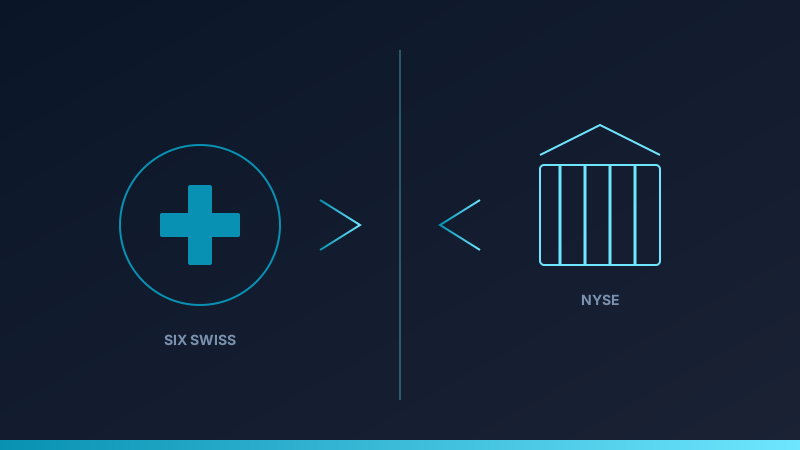
For international companies seeking public market access, the choice of listing venue has profound implications for valuation, liquidity, regulatory burden, and long-term strategic flexibility. Two venues consistently emerge as leading options: the Swiss Exchange (SIX) and the New York Stock Exchange (NYSE).
Each offers distinct advantages that align with different corporate profiles and strategic objectives. Understanding these differences is essential for making an informed decision that will shape a company's capital markets journey for years to come.
"The choice of listing venue is not merely administrative—it's a strategic decision that signals to investors, partners, and competitors how a company sees its future."
Swiss Exchange Advantages
The Swiss Exchange has established itself as a premier destination for international listings, particularly for companies seeking a sophisticated investor base without the regulatory intensity of U.S. markets.
Regulatory Efficiency
Swiss listing requirements, while rigorous, are generally considered more proportionate than their U.S. counterparts:
- Streamlined disclosure requirements focused on material information
- Faster approval timelines for listing applications
- Flexible governance structures accommodating diverse corporate forms
- Lower ongoing compliance costs compared to SEC requirements
Privacy and Stability
Switzerland's reputation for discretion extends to its capital markets:
- Strong protections for beneficial ownership information
- Political and economic stability as a neutral jurisdiction
- Established legal framework for international commerce
- Access to sophisticated European institutional investors
NYSE Advantages
The NYSE remains the world's largest stock exchange by market capitalization, offering unparalleled access to capital and liquidity.
Capital Access
NYSE listing provides access to the deepest pool of investment capital globally:
- Institutional depth with thousands of active funds and investors
- Retail participation through broad market accessibility
- Analyst coverage from major investment banks
- Index inclusion potential driving passive investment flows
Valuation and Liquidity
U.S. markets typically offer premium valuations for comparable companies:
- Higher price-to-earnings multiples for growth companies
- Superior trading liquidity reducing execution costs
- Currency exposure to the world's reserve currency
- Enhanced visibility for M&A and strategic transactions
Regulatory Considerations
The regulatory landscape differs significantly between jurisdictions, with implications for both initial listing and ongoing compliance.
SEC Requirements
U.S. listings require compliance with comprehensive SEC regulations:
- Sarbanes-Oxley Act compliance including internal control attestation
- Quarterly reporting obligations with detailed financial disclosures
- Executive compensation disclosure requirements
- Related party transaction approvals and disclosure
SIX Requirements
Swiss exchange requirements focus on transparency while maintaining proportionality:
- Semi-annual financial reporting as standard
- Ad-hoc disclosure for material events
- Corporate governance code on comply-or-explain basis
- Management transaction reporting requirements
Decision Framework
Selecting the optimal listing venue requires systematic analysis of company-specific factors and strategic objectives.
Key Considerations
- Investor base targets—Where are your ideal long-term shareholders?
- Growth strategy—Will you pursue U.S. acquisitions or expansion?
- Compliance capacity—Can you sustain SEC reporting requirements?
- Valuation sensitivity—How critical is maximum valuation multiple?
- Privacy preferences—What level of disclosure is acceptable?
Hybrid Approaches
Some companies pursue dual listings or staged approaches, starting with a Swiss listing before adding a U.S. presence. This can provide a graduated path to full U.S. market access while managing regulatory complexity.
Key Takeaways
The choice between Swiss and NYSE listings involves trade-offs that must be evaluated against specific company circumstances and objectives.
- Swiss listings offer regulatory efficiency, privacy, and access to European capital
- NYSE listings provide maximum liquidity, valuation potential, and U.S. investor access
- Regulatory burden varies significantly and impacts ongoing operational costs
- Strategic alignment with long-term business objectives should drive the decision
- Hybrid approaches may offer the best of both worlds for certain companies
At Beekman Strategic, we help international companies navigate these complex decisions with tailored analysis and execution support. Contact us to discuss your capital markets strategy.